All lessons in Workshop 1
Part 1: Getting started
Part 2: Breadboards
Part 3: Ohm's Law
- 4 Voltage, current and resistance
Part 4: LEDs and resistors
Part 5: Series and parallel
- 6 Series and parallel circuits
- 6.1 Tasks 3.1 and 3.2
- 6.2 Tasks 3.3 and 3.4
- 6.3 Task 4.1: Predict and observe
Part 6: Turn-on voltage
Ohm's Law
Voltage, current, and resistance are all connected by a single, simple rule called Ohm's Law. Before we look at the formula, here's an analogy that makes it click:
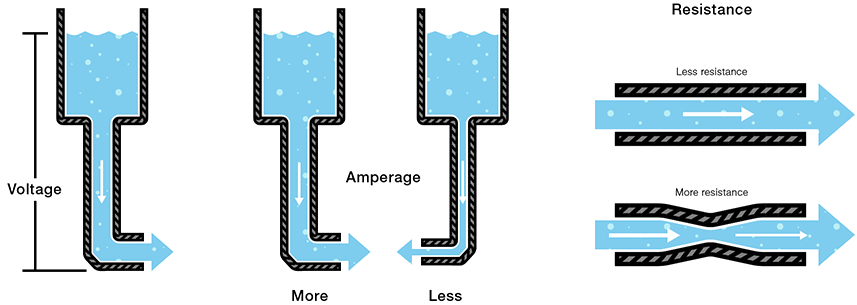
Think of voltage as water pressure, current as water flow, and resistance as the width of the pipe.
For this workshop, we'll assume the voltage supplied by the power source stays constant. If that's true, then resistance and current are inversely proportional: as resistance goes up, current goes down, and as resistance goes down, current goes up, just like a narrower pipe lets less water through.
Just as the width of a pipe controls water flow, a resistor controls current flow. If the water-main pressure is your constant voltage and the water flow is your current, the width of the pipe is your resistance. In this workshop, we use resistors with fixed values: you can think of each one as a manufactured, fixed "pipe width" that sets how much "water" (current) gets through.
Safety Corner
Notice that when resistance drops toward zero, current can become very large: that's exactly what happens in a short circuit, and it's why fuses and resistors matter even in real household wiring. The two AA batteries in this workshop are far too weak to shock you, but a short circuit drains them fast and can make a wire hot. It's a good habit to always ask yourself: "where is the resistance in this circuit?"